New energy pattern observed at National High Magnetic Field Laboratory
Source: tgdaily.com
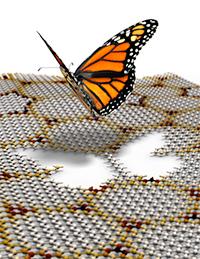 Two research teams at the National High Magnetic Field Laboratory (MagLab) smashed through a nearly 40-year barrier recently when they observed a never-before-seen energy pattern.
The butterfly-shaped pattern was first theorized by physicist Douglas Hofstadter in 1976, but it took the tools and technology now available at the MagLab to prove its existence.
"The observation of the ’Hofstadter butterfly’ marks a real landmark in condensed matter physics and high magnetic field research," said Greg Boebinger, director of the MagLab. "It opens a new experimental direction in materials research."
This groundbreaking research demanded the ability to measure samples of materials at very low temperatures and very high magnetic fields, up to 35 tesla. Both of those conditions are available at the MagLab, making it an international destination for scientific exploration.
The unique periodic structure used to observe the butterfly pattern was composed of boron nitride (BN) and graphene. Graphene is a Nobel Prize-winning material that holds tremendous promise in revolutionizing computers, batteries, cell phones, televisions and even airplanes. A one-atom thick, honeycomb array of carbon atoms, graphene is virtually see-through, yet 300 times stronger than steel and 1,000 times more conducting than silicon.
"This is about a puzzle that has been solved," said Eric Palm, deputy director at the MagLab. "It is really about scientific curiosity. It is an exciting confirmation of a theory that was made years ago."
MagLab physicist Nicholas Bonesteel agreed, adding "The Hofstadter butterfly is a beautiful fractal energy pattern that has intrigued physicists for decades. Seeing clear experimental evidence for it is a real breakthrough."
[...]
Read the full article at: tgdaily.com
What the teams did was place graphene – a layer of carbon just one atom thick – on an extremely flat surface of a boron-nitride crystal. As both materials have similar hexagonal structures, the researchers observed "Moiré patterns", which are regular patterns created whenever two similar 2D lattices are overlaid. (The Manchester and MIT groups used single-layer graphene, while the Columbia-led experiment involved bilayer graphene.) By tweaking the relative orientation of the two lattices, the teams were able to create superlattices with appropriate spacing. Source
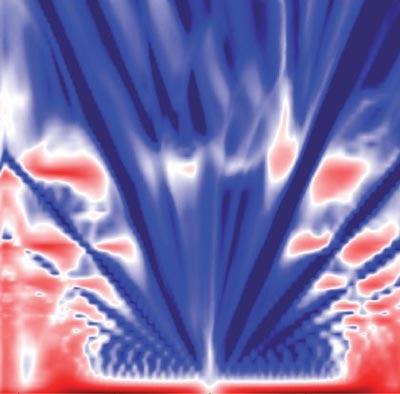
Butterfly seen at long last