The 70th Anniversary of the Bombing of Nagasaki
Source: lewrockwell.com
Unwelcome Truths for Church and State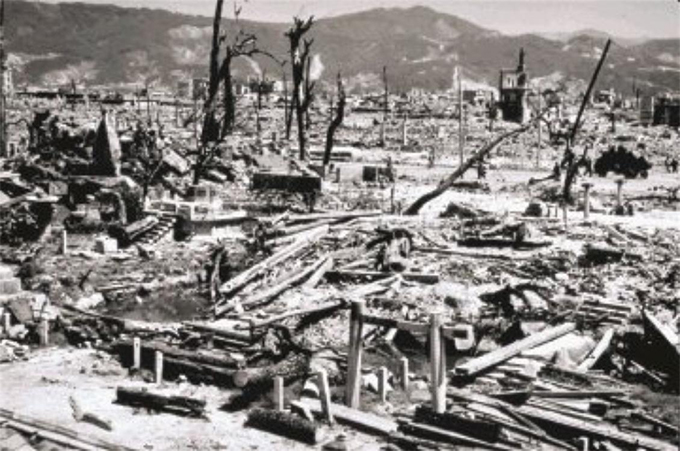
“An irradiated crucifix lies in the ruins of the Urakami Cathedral Following the Atomic Bombing of Nagasaki”
70 years ago (August 9, 1945) an all-Christian bomber crew dropped a plutonium bomb over Nagasaki City, Japan, instantly vaporizing, incinerating or otherwise annihilating tens of thousands of innocent civilians, a disproportionately large number of them Japanese Christians. The explosion mortally wounded uncountable thousands of other victims who succumbed to the blast, the intense heat and/or the radiation.
In 1945, the US was regarded as the most Christian nation in the world (that is, if you can label as truly Christian a nation whose churches are proponents of eye-for-an-eye retaliation, are supportive of America’s military and economic exploitation of other nations or otherwise fail to sincerely teach or adhere to the ethics of Jesus as taught in the Sermon on the Mount).
Ironically, prior to the bomb exploding nearly directly over the Urakami Cathedral at 11:02 AM, Nagasaki was the most Christian city in Japan, and the massive cathedral was the largest Christian church in the Orient.
Those baptized and confirmed Christian airmen, following their wartime orders to the letter, did their job efficiently, and they accomplished the mission with military pride, albeit with an astonishing number of near-fatal glitches in the mission. Most of us Americans would have done what the crew did if we had been in the shoes of the Bock’s Car crew. And, if we had never seen, heard or smelled the suffering humanity that the bomb caused on the ground, and if we had been treated as heroes in the aftermath, most of us would have experienced no remorse for our participation in what was retrospectively universally regarded as a war crime.
Indeed, the use of the most monstrous weapons of mass destruction in the history of warfare, was later defined by the Nuremberg Tribunal as an international war crime and a crime against humanity.
Of course, there was no way that the crew members knew that at the time of the mission. Some of the crew did admit that they had had some doubts about what they had participated in after the bomb actually detonated. But none of them actually witnessed the horrific suffering of the victims up close and personal. “Orders are orders” and disobedience in wartime is severely punishable, even by summary execution, so the crew obeyed the orders.
Making It Hard for Japan To Surrender
It had been only 3 days since the August 6th bomb had incinerated Hiroshima. The Nagasaki bomb was dropped amidst massive chaos and confusion in Tokyo, where the fascist military command was just beginning a meeting with the Emperor to discuss how to surrender with honor. The military and civilian leadership of both nations had known for months that Japan had lost the war.
The only obstacle to ending the war had been the Allied Powers insistence on unconditional surrender, which meant that the Emperor Hirohito would have been removed from his figurehead position in Japan and perhaps even subjected to war crime trials. That demand was intolerable for the Japanese, who regarded the Emperor as a deity.
The USSR had declared war against Japan the day before (August 8), hoping to regain territories lost to Japan in the humiliating (for Russia) Russo-Japanese War 40 years earlier, and Stalin’s army was now advancing across Manchuria. Russia’s entry into the war had been encouraged by President Truman before he knew of the success of the atom bomb test in New Mexico on July 16.
But now, Truman and his strategists knew that the bomb could elicit Japan’s surrender without Stalin’s help. So, not wanting to divide any of the spoils of war with the USSR, and because the US wanted to send an early cold war message to Russia that the US was the new planetary superpower, Truman ordered bomber command to proceed with using the atomic bombs as weather permitted and as they became available (although no more fissionable material was actually available to make a fourth bomb).
The Decision To Target Nagasaki
August 1, 1945 was the earliest deployment date for the Japanese bombing missions, and the Target Committee in Washington, D.C. had already developed a list of relatively un-damaged Japanese cities that were to be excluded from the conventional USAAF (US Army Air Forces) fire-bombing campaigns (that, during the first half of 1945, had used napalm to burn to the ground over 60 essentially defenseless Japanese cities).
The list of protected cities included Hiroshima, Niigata, Kokura, Kyoto and Nagasaki. Those five cities were to be off-limits to the terror bombings that the other cities were being subjected to. They were to be preserved as potential targets for the new “gimmick” weapon that had been researched and developed in labs and manufacturing plants all across America over the several years since the Manhattan Project had begun.
Ironically, prior to August 6 and 9, the residents of those five cities considered themselves lucky for not having been bombed as had the other large cities. Little did the residents of Hiroshima and Nagasaki know that they were only being temporarily spared from an even worse carnage in an experiment with a new weapon that could cause the mass destruction of entire cities that were populated with hundreds of thousands of live human guinea pigs.
The Trinity Test
The first and only field test of an atomic bomb had been blasphemously code-named “Trinity” (a distinctly Christian term). That experiment had occurred in secrecy 3 weeks earlier at Alamogordo, New Mexico, on July 16, 1945. The results were impressively destructive, but the blast had just killed a few hapless coyotes, rabbits, snakes and some other desert varmints. That plutonium bomb at Alamogordo had been identical to the Nagasaki bomb.
Trinity also produced huge amounts of an entirely new type of rock that was later called “Trinitite”. Trinitite was a radioactive molten lava rock that had been created from an intense heat that was twice the temperature of the sun.
At 3 am on the morning of August 9, 1945, a B-29 Superfortress bomber (that had been “christened” Bock’s Car) took off from Tinian Island in the South Pacific, with the prayers and blessings of the crew’s Lutheran and Catholic chaplains.
Barely making it off the runway before the heavily loaded plane went into the ocean (the bomb weighed 10,000 pounds), it headed north for Kokura, the primary target. Bock’s Car’s bomb was code-named “Fat Man,” partly because of its shape and partly to honor the rotund Winston Churchill. “Little Boy”, first called “Thin Man” (after President Roosevelt), was the code name of the uranium bomb that had been dropped on Hiroshima three days earlier.
Nagasaki Was Being Incinerated as the Japan’s War Council Was Again Debating Surrender Terms
Japan’s Supreme War Council in Tokyo, scheduled to convene their next meeting at 11 am on August 9, had absolutely no comprehension of what had really happened at Hiroshima. So the members were not inclined to heighten their sense of urgency concerning the issue of surrendering. The council was mostly concerned about Russia’s declaration of war than what was happening – as they were meeting – at Nagasaki.
But it was already too late, because by the time the War Council members were arising and heading to the meeting with the emperor, there was no chance to alter the course of history. Bock’s Car – flying under radio silence – was already approaching the southern islands of Japan, heading for Kokura, the primary target. The crew was hoping to beat an anticipated typhoon and the clouds that would have caused the mission to be delayed.
The Bock’s Car crew had instructions to drop the bomb only on visual sighting. But Kokura was clouded over. So after making three failed bomb runs over the clouded-over city and experiencing engine trouble on one of the four engines – using up valuable fuel all the while – the plane headed for its secondary target, Nagasaki.
The History of Nagasaki Christianity
Nagasaki is famous in the history of Japanese Christianity. The city had the largest concentration of Christians in all of Japan. St. Mary’s Cathedral was the megachurch of its time, with 12,000 baptized members.
Nagasaki was the community where the legendary Jesuit missionary Francis Xavier planted a mission church in 1549. The Catholic community at Nagasaki grew and eventually prospered over the next several generations. However it eventually became clear to the Japanese that the Catholic Portuguese and Spanish commercial interests were exploiting Japan. It only took a couple of generations before all Europeans – and their foreign religion – were expelled from the country.
From 1600 until 1850, being a Christian in Japan was a capital crime. In the early 1600s, Japanese Christians who refused to recant of their faith were subject to unspeakable tortures – including crucifixion. But after a mass crucifixion occurred, the reign of terror expired, and it appeared to all observers that Japanese Christianity was extinct.
However, 250 years later, after the gunboat diplomacy of US Commodore Matthew Perry forced open an offshore island for American trade purposes, it was discovered that there were thousands of baptized Christians in Nagasaki, living their faith in secret in a catacomb-like existence, completely unknown to the government.
With this revelation, the Japanese government started another purge; but because of international pressure, the persecutions were stopped and Nagasaki Christianity came up from the underground. By 1917, with no financial help from the government, the re-vitalized Christian community had built the massive St. Mary’s Cathedral in the Urakami River district of Nagasaki.
Christians Killing Christians in the Name of Christ
So it was the height of irony that the massive Cathedral – one of only two Nagasaki landmarks that could be positively identified from 31,000 feet up (the other one was the Mitsubishi armaments factory complex, which had run out of raw materials because of the Allied naval blockade) became Ground Zero for Fat Man.
At 11:02 am, during Thursday morning mass, hundreds of Nagasaki Christians were boiled, evaporated, carbonized or otherwise disappeared in a scorching, radioactive fireball that exploded 500 meters above the cathedral. The black rain that soon came down from the mushroom cloud contained the mingled cellular remains of many Nagasaki Shintoists, Buddhists and Christians. The theological implications of Nagasaki’s Black Rain surely should boggle the minds of theologians of all denominations.
[...]
Read the rest: lewrockwell.com