The Troubling Question in the French Jewish Community: Is It Time to Leave?
Source: vanityfair.com
‘How can anyone be allowed to paint a swastika on the statue of Marianne, the goddess of French liberty, in the very center of the Place de la République?”
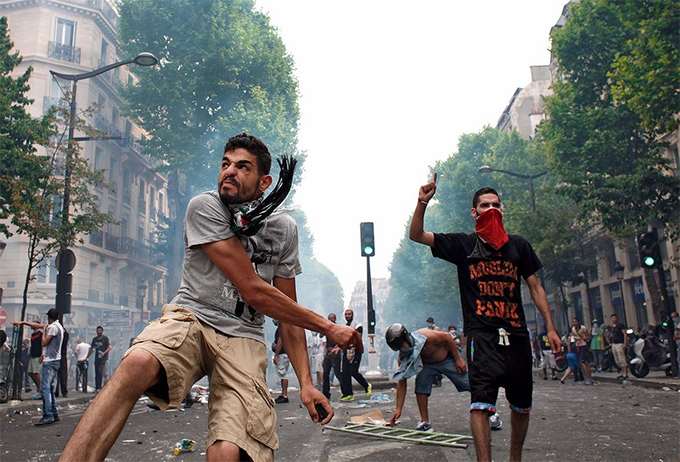
That was what the chairman of one of France’s most celebrated luxury brands was thinking last July, when a tall man in a black shirt and a kaffiyeh leapt to the ledge of Marianne’s pedestal and scrawled a black swastika. All around him, thousands of angry demonstrators were swarming the square with fake rockets, Palestinian and Hamas flags, even the black-and-white banners of ISIS. Here, barely a mile and a half from the Galeries Lafayette, the heart of bourgeois Paris, the chants: “MORT AUX JUIFS! MORT AUX JUIFS!” Death to the Jews. It was Saturday, July 26, 2014, and a pro-Palestinian demonstration turned into a day of terror in one of the most fashionable neighborhoods of the city.
“Do something! Do you see what is happening here?” the chairman said to a line of police officers watching the demonstration build to a frenzy. “What do you expect us to do?” one officer said, then looked away. For years, the chairman, a longtime anti-racism activist, has turned up at rallies like this one to see which politicians and which radical groups were present. (For reasons of personal safety, the chairman asked not to be identified for this story.) France’s endless demonstrations are a mainstay of the republic, a sacred right rooted in the legacy of Voltaire. But hate speech is a criminal offense—people may express their opinions, but not to the extent of insulting others based on their race, religion, or sex. The protest—against Israel’s Gaza policies—had been banned by the government, fearful of violence, following flare-ups in the preceding weeks. But if the police were to move in too quickly, the riots might continue all summer long—suburbs in flames, mobs in central Paris.
Photographs and videos of the swastika and its perpetrator, of protesters chanting “Kill the Jews,” and of the Palestinian, Hamas, and ISIS flags were sent in a rush to various groups in the Jewish community who assess threats. By early afternoon, some of these reached Sammy Ghozlan, a 72-year-old retired police commissioner who has spent his career working the banlieues, the belt of working-class, racially mixed suburbs that surround Paris. Ghozlan is a folk hero of the banlieues and has a nickname that is impossible to forget: le poulet cacher—“the kosher chicken.” (Poulet is slang for cop.) For 15 years, he has overseen France’s National Bureau for Vigilance Against Anti-Semitism—known by its French abbreviation, B.N.V.C.A.—a community hotline he founded that is funded by his police pension and whatever small donations he can come by. Its purpose is nothing less than to protect the Jews of France.
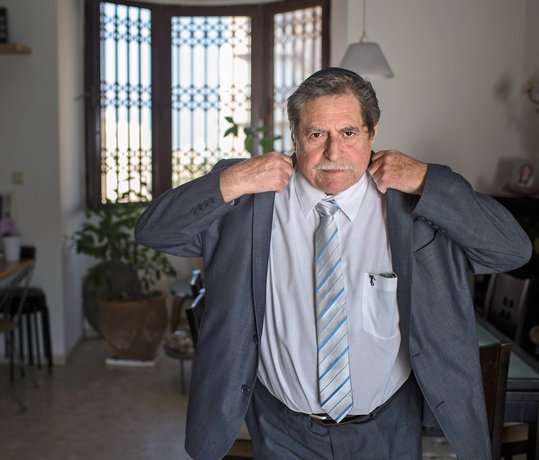
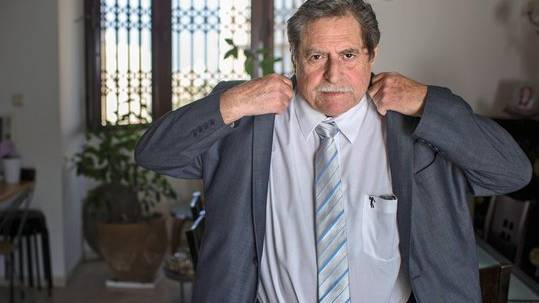
Sammy Ghozlan, photographed by Uriel Sinai, at his new home, in Netanya, Israel. By Uriel Sinai.
This past year, Ghozlan’s frequent bulletins—detailing attacks in parks, schools attacked, synagogues torched, assaults on the Métro—have clogged the in-boxes of reporters at Le Monde, Le Figaro, and Le Parisien, and of thousands of Jews throughout the banlieues. Ghozlan’s bulletins sometimes come twice a day, with claims that have also been backed up by hard numbers: according to a watchdog group, the Jewish Community Protection Service, or S.P.C.J., which reports statistics collected by the country’s Interior Ministry, there were 851 recorded anti-Semitic incidents in France in 2014, more than doubling the total from 2013. Ghozlan and his 19 volunteers are on the front lines in the most troubled areas, documenting, trying to confirm, hoping to get a reporter or a police prefect or a court to take action. There has been such an uptick, and such a flurry of alerts from Ghozlan over the past year, that there’s always a risk that his efforts will be shrugged off as yet another nuisance.
Just two weeks before the July 26 riot, Ghozlan’s texts and messages did not stop. It was Bastille Day weekend, and, on Sunday, July 13, he tracked the hundreds of protesters who rushed into the Marais, Paris’s historic Jewish quarter, stopping briefly at an empty synagogue on the Rue des Tournelles, near the Place des Vosges, and then racing, reportedly with iron bars, axes, and flags, toward the Rue de la Roquette, a boutique-and-café-lined street a few blocks from the apartment of Prime Minister Manuel Valls. Their destination was the Don Isaac Abravanel synagogue. Inside, the 200 worshippers—including the chief rabbi of Paris—heard the howls from the crowd, estimated to number about 300: “Hitler was right!” “Jews, get out of France!” Audrey Zenouda, a policewoman who happened to be inside the synagogue, called her father, a retired policeman who works with Ghozlan at the B.N.V.C.A. “Do something. We are terrified here.”
“I knew that if anyone could get the police to take action it would be Sammy and the B.N.V.C.A.,” Zenouda later told me. Only six police officers were assigned to be on demonstration duty that day. “We are waiting for the assault police to arrive,” one told a reporter at the scene. After an hour, a counterterrorism force rescued the chief rabbi, but everyone else was left inside, behind doors barricaded from the inside with chairs and tables. Outside, members of a special security patrol and a dozen members of the self-trained Ligue de Défense Juive began chasing off the demonstrators with chairs and tables from nearby cafés, working with a small unit from the security force. Together, it took them three hours to disperse the crowd and safely evacuate the synagogue.
Almost immediately afterward, the reports of the July 13 demonstration would be challenged and debated. The numbers would be skeptically parsed—were there really so many?—and questions would be asked about actions that might have provoked the violence, as if carrying iron bars and axes around central Paris might be normal. In some circles, there were even accusations that the Jews “brought on the behavior,” as they always do.
In the crowd—and many others that would turn the summer of 2014 into a summer of hate in Paris—were representatives of France’s political parties, both left and right. France’s Muslim population is estimated to be around 5 million, a potential voting bloc in a country of 66 million. (The Jewish population of France is in the neighborhood of 500,000.) Shimon Samuels, the director for international relations at the Simon Wiesenthal Center in Paris—which combats anti-Semitism, Holocaust denial, and extremism, and, through a foundation, helps to fund Ghozlan’s hotline—witnessed some of the events of July 13. Among those he recognized in the crowd were a local concierge and bank teller, along with members of the current Socialist government.
Monitoring the footage later, Ghozlan was sickened to see the faces of political allies he had worked with for decades, mostly in what is known as Le Neuf Trois (“9–3”), the area of northern Paris suburbs that he once presided over as a commissioner of police. Le Neuf Trois is the rap name for this district, which has the honor of being, by reputation anyway, the most violent in France. (The name derives from the area’s postal codes, which all begin with “93.”) It is also where Ghozlan lived for 30 years in a spacious house surrounded by hedges on the Avenue Henri Barbusse in the relatively calm community of Le Blanc-Mesnil.
For Ghozlan, July 2014 was the tipping point, after years of escalating anti-Semitic violence: “There was no debate in our family. We all knew—it is time to go. Leaving is better than running away,” Ghozlan later told me. He would ultimately come to think of the summer riots as the predictors of the catastrophes that would play out six months later in the terror attacks at the offices of the satirical weekly Charlie Hebdo, three quarters of a mile from the Place de la République, on January 7, 2015, and then, two days later, at Hyper Cacher, a kosher grocery store in the Porte de Vincennes neighborhood of eastern Paris.
By then Ghozlan’s classified ad—one nobody who knows him could ever have thought possible—had already been posted: “Renting a house, 4 rooms, 2 bathrooms, a veranda, a garden with 50 m. square.” Two days before the Charlie Hebdo attack, Sammy announced what, to many, including me, was unthinkable: Sammy Ghozlan, proud Frenchman and the dean of Paris’s anti-Semitic crime-fighters, had joined the thousands of French Jews moving to Israel.
The Sephardic Columbo
More than a decade ago, I spent weeks with Ghozlan at the height of the second intifada, the Palestinian uprising against Israeli occupation that began in September of 2000 and lasted more than four years. Ghozlan had recently started the B.N.V.C.A. hotline and was working from a crammed back room in a synagogue in Le Pré-Saint-Gervais. When I first met him, in the fall of 2002, Ghozlan carried a white plastic binder bulging with one-page reports written up from the calls he’d received from tipsters. All day and all night his phone would ring. It never left his hand. More than 300 reports were in that binder: Molotov cocktails thrown at Jewish schools, students called sale Juif (“dirty Jew”), arsons, desecrations, a Jewish woman beaten in a taxi. The attacks on the Jews of France had yet to catch the attention of the international press, and Ghozlan could get almost no one in Paris to take him seriously.
Now, 12 years later, Ghozlan’s binder is one of 50 that fill the shelves of his office in central Paris. I went to see him again last spring, when he was back in the city, having undergone surgery to repair a tendon in his leg. The B.N.V.C.A. was still operating, with Ghozlan monitoring from Netanya, a seaside town near Tel Aviv, where as many as 2,000 French Jews immigrated to in 2014, and where Ghozlan moved last December, coming back to Paris every six weeks or so.
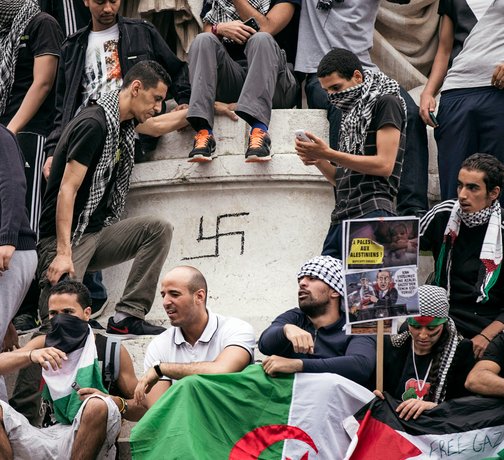
The base of the Statue de la République is defaced with a swastika as a protest in support of Palestinians turns anti-Semitic, Paris, July 26, 2014. By Etienne Laurent/EPA/Corbis.
Ghozlan resembles a beat-up version of Yves Montand, and the decade since we had seen each other only heightened the effect. Otherwise, not much had changed. He still wears the neat blazer and open shirt that suggest his native North Africa. (He was born in Algeria.) And he was still constantly on the phone, issuing directives to investigate allegations of anti-Semitism. He dispatched volunteer lawyers to the courts to try to stop marauding anti-Israel protesters who stripped kosher and Israeli products from supermarket shelves. And he was entrenched in a longtime legal battle against the anti-Semitic, Holocaust-denying comedian Dieudonné M’bala M’bala, who was recently convicted in Paris of condoning terrorism. “This case obsesses me,” Ghozlan told me. “I have been filing against him for 10 years.” On his iPhone, he shows me dozens of pictures of Dieudonné’s fans in front of the Hyper Cacher, after the bloody hostage crisis of January 9, making the sign of the “quenelle,” a Nazi-style salute that Dieudonné created and popularized.
It had been two months since that attack, and Ghozlan was fixated on trying to make sense of what had happened inside the Hyper Cacher, where a 32-year-old terrorist named Amedy Coulibaly, who had grown up in a Paris suburb with his Malian parents, massacred four people in a quiet area of bobos and professionals in Porte de Vincennes. He wore a GoPro video camera strapped to his torso to record the slaughter. He reportedly announced to his hostages: “I am Amedy Coulibaly, Malian and Muslim. I belong to the Islamic State.” By the time the siege was over, four French Jews were dead, including one young man who grabbed a gun that Coulibaly had left on a counter because it had jammed. The day before, Coulibaly had killed a policewoman who was investigating a traffic accident in the suburb of Montrouge.
When news flashed of the Montrouge shooting, Ghozlan was following the situation from Netanya. He had an instinct and contacted a close friend in another Jewish organization who lived nearby. “This morning attack in Montrouge,” he wrote. “Can you check to see if this was near the [Jewish] school?” The answer came: “You are right. The school is close. There are rumors, but you are wrong. We are there and the school is not the target.” Later reports indicated that a Jewish school in Montrouge may actually have been Coulibaly’s original target. In Netanya, Ghozlan had yet to unpack his furniture, but he was already making plans to get back to Paris.
Moving back permanently was out of the question, but it hasn’t been easy for Ghozlan to disconnect. “I am deeply French,” he told me. “I did my military service in the air force. I love France’s values, its culture, its history, its cuisine, philosophers, and artists. I never imagined that I would someday leave. I led the fight for 15 years and all our warnings made no difference.” In 2014, about 7,000 Jews left France for Israel, and this year the anticipated exodus is between 10,000 and 15,000. The Jewish Agency for Israel recently reported that, in 2014, 50,000 French Jews made inquiries about moving to Israel, an astonishing number. In many of France’s public lycées, Jewish students are insulted, classrooms are vandalized, books are defaced, and fights break out in the classroom with any attempt to teach the Holocaust. After the Charlie Hebdo and Hyper Cacher attacks, there were reports that classes were disrupted when some Muslim students refused to participate in any memorial for the victims. According to Shimon Samuels, about 40 percent of France’s Jewish students are now in Jewish schools and 35 percent in Catholic schools. “This is an unprecedented situation,” Ghozlan tells me. “We are in new territory here.”
Ghozlan’s phone rings. When he hangs up, he tells me of two unidentified Muslim men who have swept into a Jewish school in Paris’s well-heeled 16th Arrondissement. (Earlier that week, there had been an incident at another Jewish school, in the 11th Arrondissement, an area of professionals, politicians, and writers.) “How did these thugs get into the school?” Ghozlan asks. “They walked around as if they were staking it out.” The school in the 16th was evacuated and the bomb squad deployed. None of this will appear in the press, Ghozlan says. There is a fear in the schools that they will lose more students.
Ghozlan’s voice is the first thing that commands attention—his inflection is almost musical. A part of Ghozlan’s celebrity in the banlieues is his reputation as a former bandleader who played three instruments and oversaw orchestras that worked the Jewish-wedding and Bar Mitzvah circuit in Paris, advertising “Groove, Funck, Hassidiques, Israélien … Oriental.” He learned his limited English by lip-synching to Gloria Gaynor’s “I Will Survive.”
Like 70 percent of France’s Jewish population, Ghozlan is Sephardic, part of the group from North Africa called pieds-noirs (“black feet”). He lived in the Algerian city of Constantine until 1962, when, at age 20, he fled the country with his family in the wake of the Algerian war, taking with him just “a sandwich and a suitcase,” a commonly used pied-noir expression. With his wife, Monique, a petite kindergarten teacher he met when they were both in a Jewish youth group in Algeria, he lived in the house in Le Blanc-Mesnil. There were bedrooms for his three daughters and one son, and his mother, who never missed an episode of NYPD Blue. When I first met Ghozlan, he struck me as a Sephardic Columbo. Early in his police career, he managed to negotiate order in a part of the banlieues that was so violent it was nicknamed Chicago. His method was to offer judo classes to the immigrant populations—many of which spoke Arabic, as Ghozlan does. He was assigned to take care of juvenile offenders, who seemed to respond to his direct style and lack of hyperbole, which he had learned, he told me, from his father, a former chief of detectives in Constantine.
Ghozlan made his counterterrorism reputation when the synagogue on the Rue Copernic was bombed in 1980, an attack that killed 4 people and injured more than 40. Ghozlan learned that the perpetrators were Palestinian sympathizers, not the neo-Nazis the police first suspected. He was made special commissioner to investigate the next major anti-Semitic attack, on Chez Jo Goldenberg, a landmark Jewish restaurant in the Marais, where 6 people, including two Americans, were killed, and another 22 wounded, in 1982. Ghozlan’s police career—always running alongside his Bar Mitzvah shows—eventually brought him to head the department in Aulnay-sous-Bois, in Seine-Saint-Denis. He retired in 1998 and in 2000 started the B.N.V.C.A., finding himself almost alone in his fight to protect the Jews of the banlieues.
Ghozlan has been awarded the Légion d’Honneur, France’s highest tribute. But his urgency has always made him an outlier, an annoyance to the assimilation-conscious, largely secular Jewish establishment concentrated in Paris’s preferred arrondissements, who still view him as a publicity hound from the banlieues, a Jew who does not know when not to react. However noble Ghozlan’s motives, he makes a nuisance of himself with his incessant press releases, I was told a decade ago. That sentiment hasn’t changed in some quarters.
When I originally met Ghozlan, he railed that his jerry-rigged detective agency had to deal with a rigid French justice system. To register a hate crime in France—which comes with a higher level of punishment than an ordinary crime—he would have to appear in front of a magistrate, who was generally loath to call the beating of a rabbi in the Métro an act of anti-Semitism. For them, Ghozlan said, it was a “simple assault,” usually committed by an unemployed French Muslim acting out of frustration. This enraged Ghozlan. “I wanted to start a Jewish defense force,” Ghozlan told me. Judge after judge told him, “There is no anti-Semitism charge applicable unless someone dies.” The party line of the Establishment Jewish organizations in Paris was always “Sammy, stop rocking the boat.” Back then, even David de Rothschild, the banker, told The**Jerusalem Post that the wave of attacks was likely coming from “neo-Nazis, a hostile, aggressive, antisemitic, right-wing population … ” He soon changed his mind.
[...]
Read the rest: vanityfair.com