Groupthink in Sweden
Source: theoccidentalobserver.net
Sweden has become something of a paradigm of what’s wrong with the West, but one doesn’t expect light to be shed on the subject in an article on the false confessions of a Swedish man. However, this article has an interesting observation. The basic facts:
Sture Bergwall … confessed to 30 killings in the 1970s and 80s and to dismembering and eating some of his victims. In trials beginning two decades ago he was convicted and locked up in an institution for the criminally insane.
But, in a story redolent of the darkest Nordic crime fiction, doubts continued to swirl around the case until an investigative journalist, the late Hannes Råstam, demonstrated that the confessions had no basis in fact. (“Lawyers blame groupthink in Sweden’s worst miscarriage of justice“)
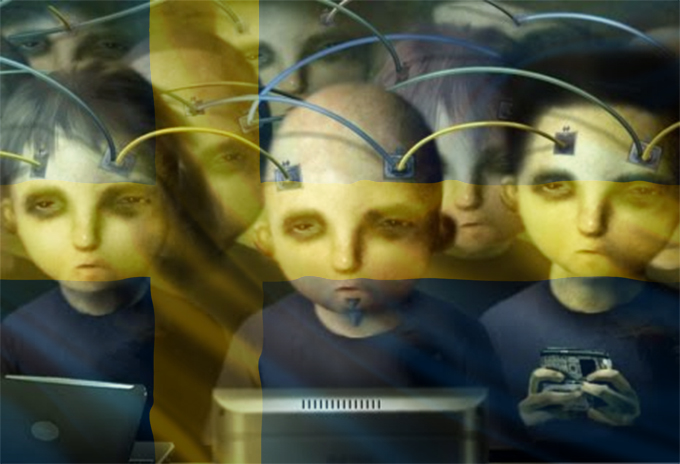
The false confessions have led to soul searching in the Swedish legal community and, as the title of the article indicates, the explanation is “groupthink.”
“In hindsight, it is easy to see mistakes in the Bergwall affair,” the commission in Stockholm said on Friday.
“When the same people participated in all or most of it, a groupthink developed … Strong trust between people is often described as one of Sweden’s great assets [but] it can not replace a critical approach to serious allegations, even when they are self-accusations,” it said in a newspaper article accompanying its report.
Strong social trust is indeed a great asset of Sweden and other countries with a significant Nordic population — a legacy of the egalitarian northern hunter-gatherer culture in which group membership is conditioned not on kinship but on maintaining one’s reputation as honest, trustworthy, and as someone who upholds the moral values of the community.
I confess that I hadn’t thought of this as leading to groupthink, but it’s not at all hard to see the connection. It is another example of egalitarianism maintained by shunning, where people who stand out or dissent from group norms in any way are ostracized. This is another facet of the Jante Laws and the Tall Poppy Syndrome (see here, section titled “Scandinavian Roots of Western Egalitarianism and Sense of Fairness”) of Northern European culture: it’s not only excellence or that is punished, but any deviation from group norms, including opinions shared by group members. Egalitarian groups make decisions by consensus, not in a top-down, authoritarian manner.
It reminds me of journalist Ingrid Carlqvist‘s comments on the enforced silence on any criticism of multiculturalism in the above-ground media. Violating the silence is met with moral outrage intended to produce shunning and ostracism — in other words, enforced groupthink where people are terrified at the thought of having dissenting opinions:
In Sweden NOBODY talks about immigration problems, the death of the multiculti project or the islamisation/arabisation of Europe. If you do, you will immediately be called a racist, an Islamophobe or a Nazi. That is what I have been called since I founded the Free Press Society in Sweden. My name has been dragged through the dirt in big newspapers like Sydsvenskan, Svenska Dagbladet and even my own union paper, The Journalist.
Of course, we see the same thing throughout the West. Western societies have uniquely been high-trust societies, a point made, e.g., by Francis Fukuyama and a basic corollary of the psychology of Western individualism (see here, p. 27ff).
Finally, this intersects with the tendency for Jews to oppose the consensus of non-Jewish society — a major theme of The Culture of Critique. Jewish intellectuals have not felt any inclination to conform to the moral and intellectual consensus of Christian European cultures:
Jewish involvement in social criticism may be influenced by social identity processes independent of any practical goal such as ending anti-Semitism. Research in social identity processes finds a tendency for displacement of ingroup views away from outgroup norms (Hogg & Abrams 1988). In the case of Jewish-gentile contact, these outgroup norms would paradigmatically represent the consensus views of the gentile society. Moreover, individuals who identify themselves as Jews would be expected to develop negative attributions regarding the outgroup, and for Jews the most salient outgroup is the gentile power structure and indeed the gentile-dominated social structure generally.
Jewish ingroup status vis-à-vis the gentile world as an outgroup would be expected to lead to a generalized negative conceptualization of the gentile outgroup and a tendency to overemphasize the negative aspects of gentile society and social structure. From the social identity perspective, the Jewish tendency to subvert the social order is thus expected to extend beyond developing ideologies and social programs that satisfy specific Jewish economic and social interests and extend to a general devaluation and critique of gentile culture—“the sheer destructive power of Jewish rationalism once it escaped the restraints of the traditional community” (Paul Johnson, A History of the Jews, 1988, 291–292). (Chapter 1 of The Culture of Critique)
[...]
Read the rest: theoccidentalobserver.net